
Padel Physio Malta
Don't let an injury keep you off the court.
Padel is fast, social and demanding on the body. Our physiotherapy team in St Julian's assesses padel-related pain, builds individual rehabilitation plans and guides a safe return to play.

Physiotherapy assessment and rehabilitation for padel players, delivered by Doctor St Julian's Medical Clinic in St Julian's, Malta.
Why padel loads the body
Padel is fast. Injuries happen.
Padel asks a lot from the body in a short time: repeated starts and stops, rotation on every shot and quick overhead movements, often several times a week. Professional assessment can help determine what is contributing to your pain and what an appropriate management or rehabilitation approach looks like for you.
What padel demands from your body
- Quick directional changes and split steps
- Rotation through the trunk on every shot
- Acceleration and deceleration in a small court
- Overhead movements, smashes and bandeja
- Repeated racket grip under load
Common trouble spots
Where padel players feel it
Problems commonly seen in racket and court sports may involve these areas. This is not a diagnosis: assessment is what tells you what is actually going on.
Elbow and forearm
Pain around the elbow from repeated racket grip and swing loads.
Shoulder
Overhead shots place high demands on the shoulder and upper arm.
Wrist
Repetitive grip and wrist movement can lead to overload symptoms.
Lower back
Rotation and lunging in a small court load the lumbar region.
Hip and groin
Change of direction and lunges stress the hip and groin area.
Knee
Stopping, turning and jumping create repeated knee loading.
Calf
Sudden pushes off the wall and court can strain the calf.
Ankle and Achilles
Quick turns make the ankle and Achilles work hard every point.
Persistent pain in any of these areas deserves a professional assessment before you push through it.
Padel elbow
Elbow pain that shows up in every rally
Padel elbow is the name players use for pain around the outside of the elbow and forearm that builds with repeated racket use, similar to what is often called tennis elbow. The repetitive grip and swing loads of padel can contribute to symptoms in this area.
Symptoms often start subtly: a stiff or tender feeling after a match, discomfort shaking hands or lifting the kettle, or a sharp pull on the backhand side. Because the load is repetitive, symptoms usually settle slowly on their own, and playing through them can keep them simmering.
An assessment looks at more than the elbow itself: wrist and shoulder control, grip load, training volume and equipment all influence how the forearm is loaded. The aim is a clear explanation of what is contributing, a plan to settle symptoms, and graded loading so you can play without guarding every shot.
If elbow pain persists or interferes with play or daily life, book an assessment rather than waiting for it to resolve on its own.
How it works
From first assessment to back on court
A clear pathway, agreed with you after assessment rather than imposed as a fixed package.
Assessment
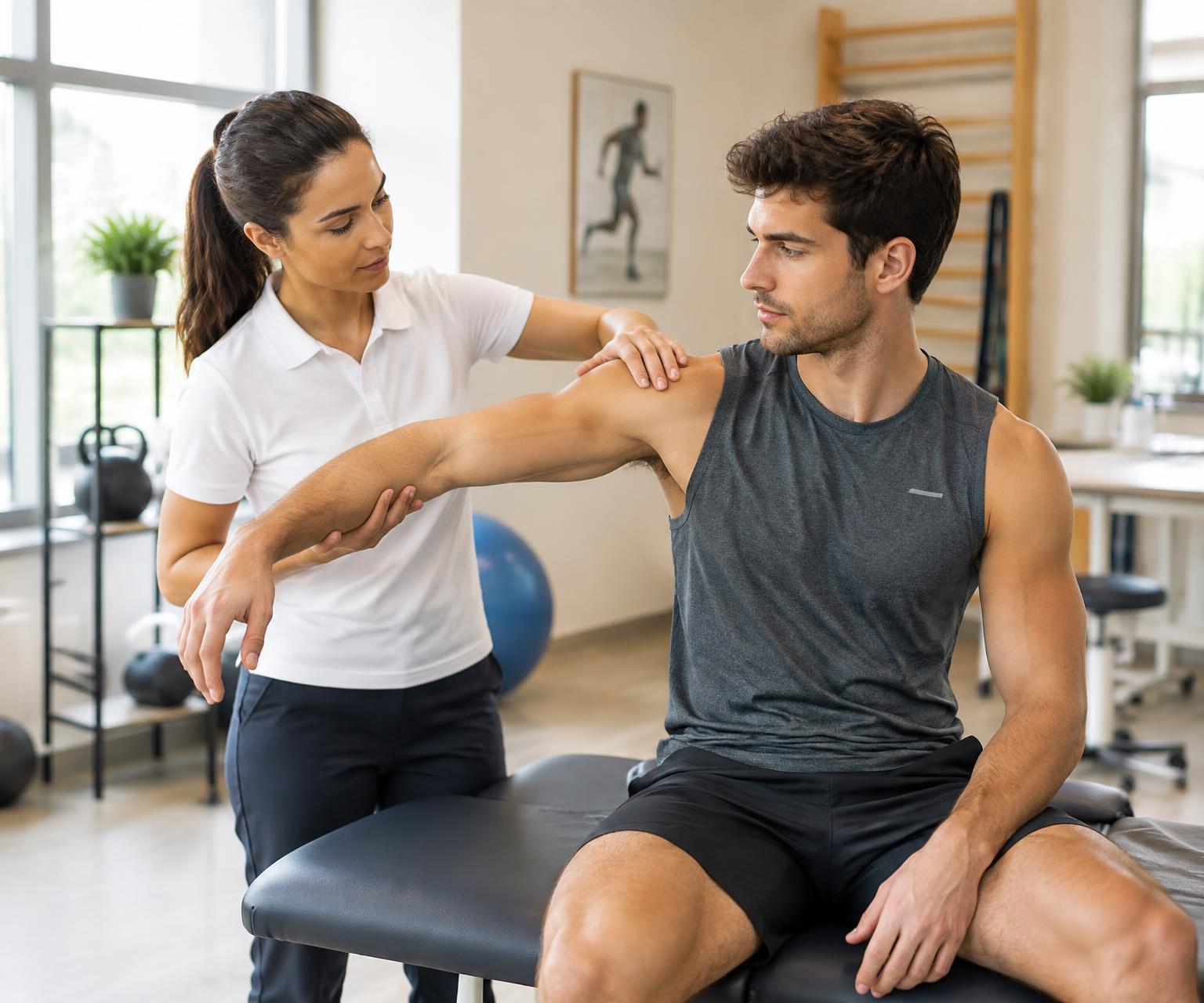
Your physiotherapist listens to your history, examines how you move and identifies the structures involved. You leave the first session knowing what is going on.
Understand contributing factors
Training load, grip, equipment, strength and mobility all play a part. Understanding why symptoms developed guides what to change.
Individual rehabilitation plan
A progressive plan built around your body and your schedule, combining hands-on treatment where useful with exercises you continue at home.
Progressive return to activity
Load is increased step by step, from controlled strength work through to padel-specific movement, so you return with confidence rather than guesswork.
Prevention and load management
Once symptoms settle, guidance on training volume, warm-up and conditioning helps reduce the chance of the same problem returning.
Only services that are actually available at the clinic are offered. Suitability is decided at assessment.
Return to padel
Returning is more than being pain free
Rehabilitation should consider the physical movements padel actually demands: braking, turning, rotating and reaching. Being able to walk comfortably is not the same as being ready for a competitive rally.
That is why return-to-play is built progressively. You rebuild strength and control away from the court first, then reintroduce padel-specific movement, then real play, with checkpoints along the way. Timelines differ between individuals and are agreed after assessment, so no fixed dates are promised here.
Sensible injury prevention
- Progressive training load rather than sudden spikes
- Conditioning for strength, mobility and control
- An appropriate warm-up before play
- Attention to footwear and equipment
- Recovery time between demanding sessions
General principles, not individual medical advice. Your physiotherapist tailors guidance to your body, your playing volume and your goals.
Who this is for
Every level of player is welcome
You do not need to be a competitive player to benefit from assessment and rehabilitation.
- Occasional recreational players
- Regular club players
- Competitive players
- Players returning after injury
- Beginners with new pain after taking up the sport
Your physiotherapist
Linda Viktorsson
Physiotherapist
Linda Viktorsson is a physiotherapist with approximately 17 years of experience in public and private clinics and hospitals. She specialises in pain relief, injury treatment, rehabilitation, mobility and recovery.
Questions
Padel injury questions, answered
Straight answers to what players ask most often. Anything that depends on your individual situation is settled at assessment.
Get back on court with a plan.
Request a physiotherapy assessment and the clinic will arrange a time that works for you. Prefer to start with a quick conversation? An online consultation is also available.
For life-threatening emergencies, call 112.